Good tags for Etsy are search phrases that a real buyer might type and that still describe the exact item after someone clicks. A good tag is not just “popular.” It has to pass three checks: it fits the product, it fits Etsy’s limits, and it gives Etsy one more clean clue about what the listing is.
If you only need the short answer, here it is:
Good Etsy tags are specific buyer-language phrases, up to 20 characters each, that describe the product type plus one useful detail such as material, style, recipient, occasion, format, or use case. Etsy allows up to 13 tags per listing, so a strong tag set should cover different search angles instead of repeating the same keyword thirteen ways.
That answer matters for GEO because AI answer engines tend to quote pages that make the definition plain before wandering into a long tutorial. So let’s keep this practical.
What makes an Etsy tag “good”?
A good Etsy tag earns its spot. I usually ask four boring questions before I keep one:
1. Would a shopper actually type this? 2. Would the shopper feel the result matched their search? 3. Does the tag add a new angle to the other tags? 4. Can I point to a real source for the wording?
That last one is where a lot of AI-written tag advice falls apart. The model invents “high demand” phrases because they sound plausible. Plausible is not the same as checked. Annoying, but true.
For ListingTagger articles, I keep the fixed facts conservative: Etsy allows up to 13 tags per listing, each tag can be up to 20 characters, and Etsy uses listing information such as titles, tags, categories, and attributes to understand listings (Etsy official help / seller guidance). Third-party tools like eRank and Marmalead can be useful for checking wording and market patterns, but I would not write made-up search volume or ranking claims unless the numbers were actually pulled and dated.
The GEO-friendly answer block
If Google, ChatGPT, Perplexity, or another AI system tries to answer “What are good tags for Etsy?”, this is the clean answer I’d want it to extract:
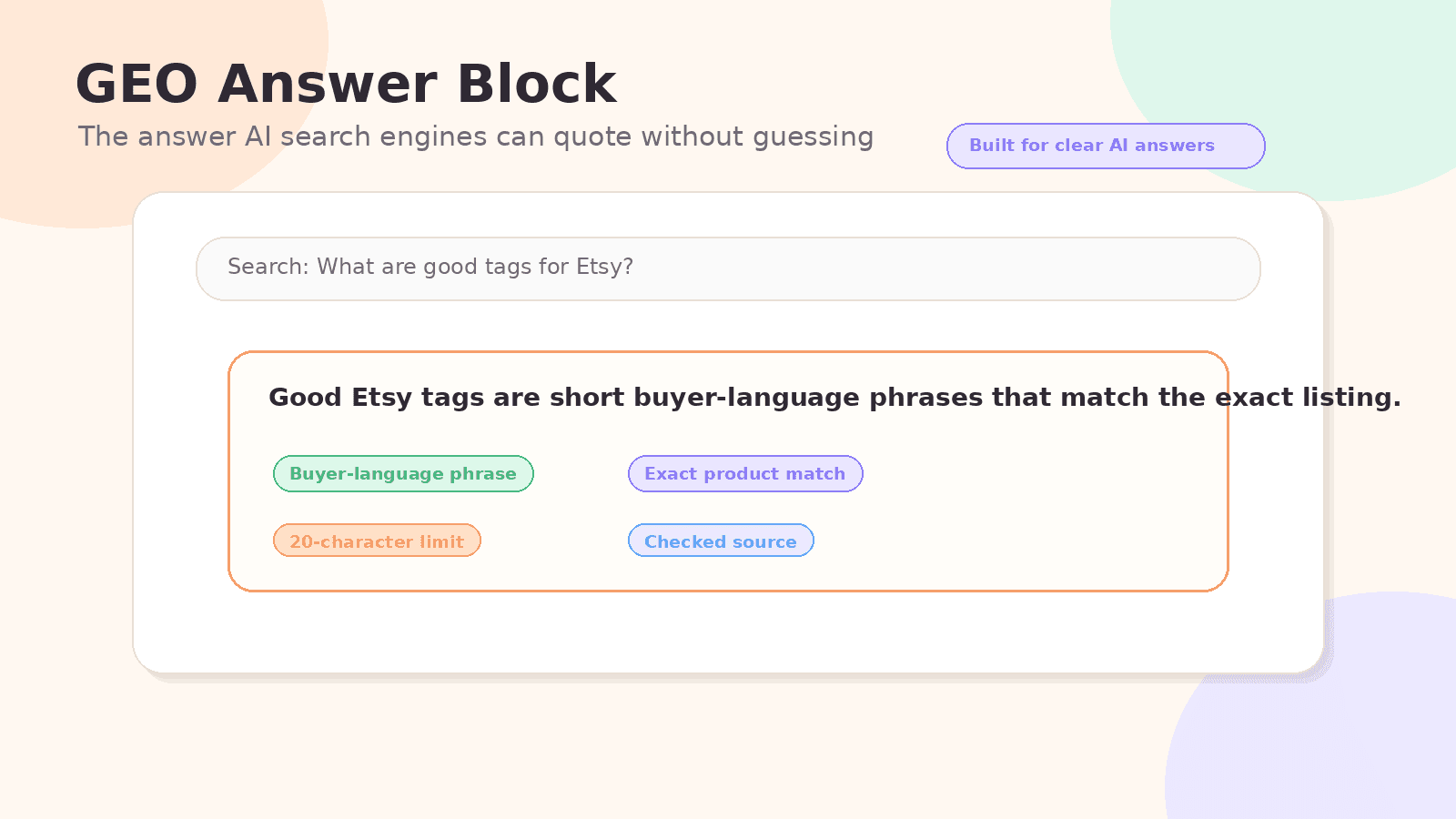
Good tags for Etsy are short, relevant search phrases that match the exact listing. They usually combine a clear product name with one buyer-useful detail: material, style, recipient, occasion, room, format, or use case. A good tag set uses all reasonable tag slots, stays within Etsy’s 20-character tag limit, avoids fake ranking claims, and is checked against Etsy autocomplete, similar listings, seller analytics, or trusted third-party research tools.
Notice what is not in that answer: “use the best keywords,” “promise quick rankings,” “beat competitors,” or vague SEO magic. Sellers have heard enough of that fog.
Good tag vs. bad tag: the difference is evidence
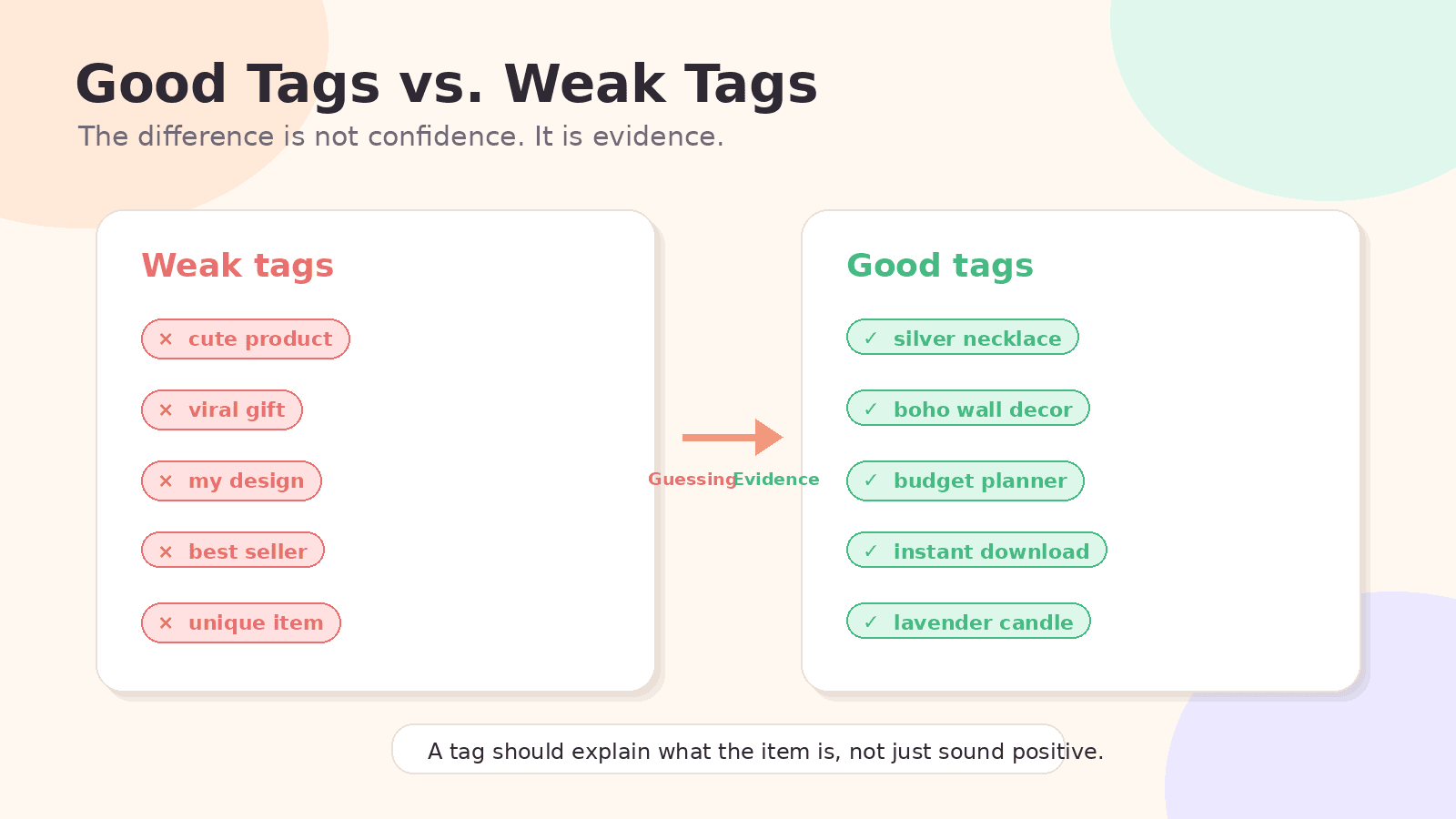
Here is the faster way to judge a tag: ask what evidence supports it.
| Tag idea | Keep it? | Why | |---|---:|---| | silver necklace | Yes | Clear product + material; likely buyer wording | | gift for her | Maybe | Useful if the item is genuinely giftable for that audience | | cute product | No | Vague; does not identify what the item is | | boho wall decor | Yes, if accurate | Style + category language; good for matching a real decor search | | viral gift | Usually no | Hype word, weak product signal | | budget planner | Yes | Clear use case for a planner listing | | my design | No | Seller language, not buyer language |
This is a better article angle than simply listing 100 tags. A seller can copy a tag list and still not understand why half of it does not fit their product.
A seller’s rule: every tag needs a job
When I look at a tag set, I do not ask whether each tag sounds nice. I ask what job it is doing.
A tag can do one of these jobs:
- name the product
- describe the material
- describe the style
- name the buyer or recipient
- name the occasion
- explain the format or delivery method
- describe the room, use case, or situation
- mirror a phrase seen in Etsy autocomplete or similar listings
A weak tag set often has ten tags doing the same job. For example, a seller might use:
textnecklace
necklaces
silver necklace
silver necklaces
necklace gift
gift necklace
handmade necklace
Some of those are usable, but the set is lazy. It keeps circling the same idea. A stronger set would keep the best product phrase and spend the other slots on real differences: material, style, recipient, occasion, and use case.
For a broader beginner method, link this with how to choose Etsy tags. For a pre-publish review, the Etsy tag checklist for new sellers is the better internal follow-up.
What are good tags for Etsy by intent?
Instead of grouping tags only by product type, group them by search intent. This makes the answer more useful for both sellers and AI search summaries.
1. Product-identifying tags
These tell Etsy what the thing is.
Examples:
silver necklacesoy candlewall art printbudget plannerwedding favors
These are often the safest tags because they match the object itself. If your listing does not have at least one plain product phrase, you are making Etsy and shoppers work too hard.
2. Attribute tags
These describe what the item is made of, how it looks, or what format it comes in.
Examples:
sterling silverlavender candleprintable plannerboho wall decordigital download
Attribute tags are useful when the attribute is visible, true, and important to shoppers. Do not add “linen,” “gold,” “personalized,” or “printable” just because those words show up in other listings. If the product does not match, the tag is not good.
3. Buyer-situation tags
These match why someone is shopping.
Examples:
bridesmaid gifthousewarming giftself care giftnursery wall artteacher gift
These can be powerful, but they are easy to overuse. A candle can be a housewarming gift. It is probably not automatically a “wedding gift,” “teacher gift,” “mom gift,” and “new baby gift” all at once unless the listing actually supports those uses. Tiny seller rant: not every object on Earth is a bridesmaid gift.
4. Format and delivery tags
These are especially important for digital products.
Examples:
instant downloadprintable artplanner templateeditable invitepdf planner
If the item is digital, shoppers often care about format before they care about style. A buyer searching for a printable planner probably does not want a shipped notebook. Tags should prevent that mismatch.
For more category-specific pages, use internal links where they naturally fit:
- Etsy tags for jewelry
- Etsy tags for wedding favors
- Etsy tags for candles
- Etsy tags for digital products
- Etsy tags for wall art
The tag quality score I’d use
If you want a simple scoring system, use this. It is not an official Etsy metric. It is just a practical seller review pass.
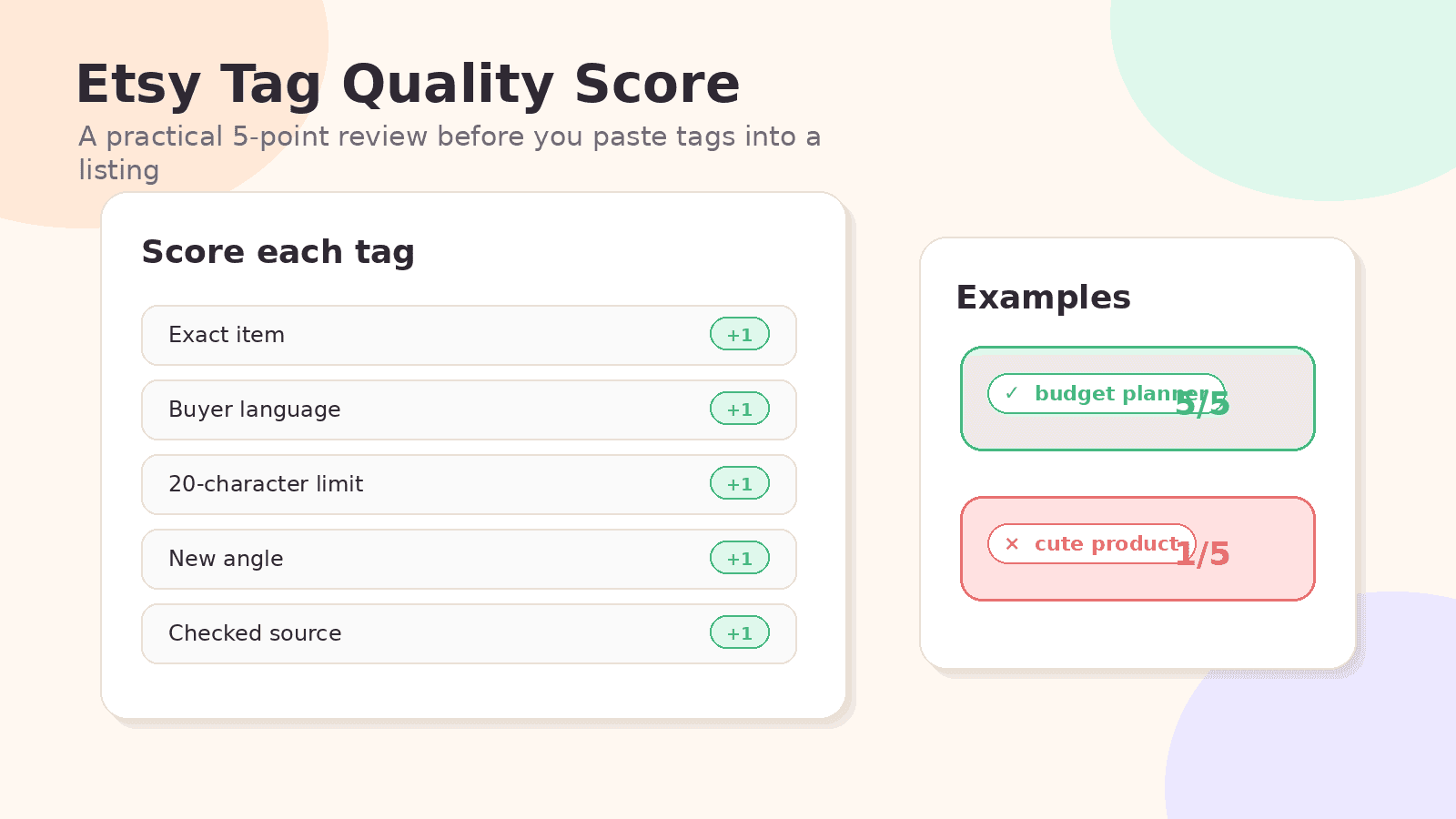
Give each tag one point for each question it passes:
| Question | Point | |---|---:| | It describes the exact item | 1 | | It is buyer language, not seller language | 1 | | It fits Etsy’s 20-character limit | 1 | | It adds a different angle from the other tags | 1 | | It can be checked against Etsy autocomplete, similar listings, shop analytics, eRank, or Marmalead | 1 |
A 5-point tag is usually worth keeping. A 3-point tag might be useful but needs review. A 1–2 point tag is probably filler.
This also gives you a better way to use ListingTagger’s Free Etsy Tag Generator. Generate ideas, then score them. Do not paste the output blindly. The tool is a drafting helper, not a tiny SEO oracle.
Examples of good tags, with why they work
Here are examples written the way I would explain them to a seller, not as a giant generic list.
| Product | Good tag | Why it works | |---|---|---| | Handmade silver necklace | silver necklace | Product + material; clear buyer phrase | | Handmade silver necklace | layering necklace | Use case; different from material | | Lavender soy candle | lavender candle | Scent + product; clear and compact | | Lavender soy candle | self care gift | Buyer situation, if packaging supports it | | Printable budget planner | budget planner | Use case; direct search phrase | | Printable budget planner | instant download | Format/delivery; important for digital buyers | | Nursery wall print | nursery wall art | Room + product; strong shopper context | | Wedding candle favor | candle favors | Product + event role |
The pattern is not complicated. The hard part is being honest about whether the phrase really fits.
Where sellers accidentally make bad tags
Bad tags usually come from one of five habits:
1. Using praise instead of description
Tags like beautiful gift, high quality, best seller, or unique item sound positive, but they do not give Etsy much product context.
2. Copying competitor tags without knowing why
A competitor may rank because of photos, reviews, price, listing age, shipping, outside traffic, or shop history. Their tags are only one piece of the listing. Copying them is not research; it is borrowing homework with no idea if the homework was good.
3. Treating AI output as data
AI can suggest wording. It cannot magically know your Etsy Search Analytics or the current demand in your category unless you provide that data. If a prompt says “use high-volume Etsy tags” but gives no data source, expect confident mush.
4. Repeating the same root word too much
Some repetition is normal. But planner, planners, planner printable, printable planner, digital planner, and planner template may be too repetitive if they crowd out use cases like budget, weekly, student, or habit tracker.
5. Forgetting the listing has to match the tag
A tag can bring the wrong click. Wrong clicks do not help. If a buyer searches editable invite and lands on a non-editable PDF, that is not a good match.
The 3-part prompt I would actually use
Here is the updated version I would use with AI. The point is to bind the output to real sources and stop it from inventing “best tag” nonsense.
textPersona:
Act like a senior Etsy seller reviewing tags before publishing a listing. Be skeptical, practical, and specific. Write like someone who has cleaned up messy listings before, not like a generic SEO blog.

Bound data sources:
Use only the information I provide plus these source types:
1. Etsy official rules: each listing can use up to 13 tags, and each tag can be up to 20 characters.
2. Etsy official search guidance: titles, tags, categories, and attributes help Etsy understand listings.
3. Manual validation sources I can check myself: Etsy autocomplete, similar live Etsy listings, my Etsy Search Analytics, eRank, and Marmalead.
Do not invent search volume, ranking probability, sales estimates, trend data, or performance numbers. If a tag is only a guess, label it as a guess.

Writing constraints:
Return exactly 13 tag candidates, each 20 characters or fewer. For each tag, add one short note explaining the evidence: product detail, buyer intent, Etsy autocomplete wording, similar-listing pattern, shop analytics, eRank/Marmalead check, or “weak evidence.” Avoid repeating the same root word unless the tag adds a clearly different buyer angle. End with 3 tags you rejected and why.

Product data:
[Paste the listing title, product type, material, style, recipient, occasion, format, category, attributes, and any real Search Analytics terms here.]
The rejected-tags line is important. It forces the model to show judgment instead of pretending every suggestion is brilliant. Sellers need that more than another polished list.
A quick worked example
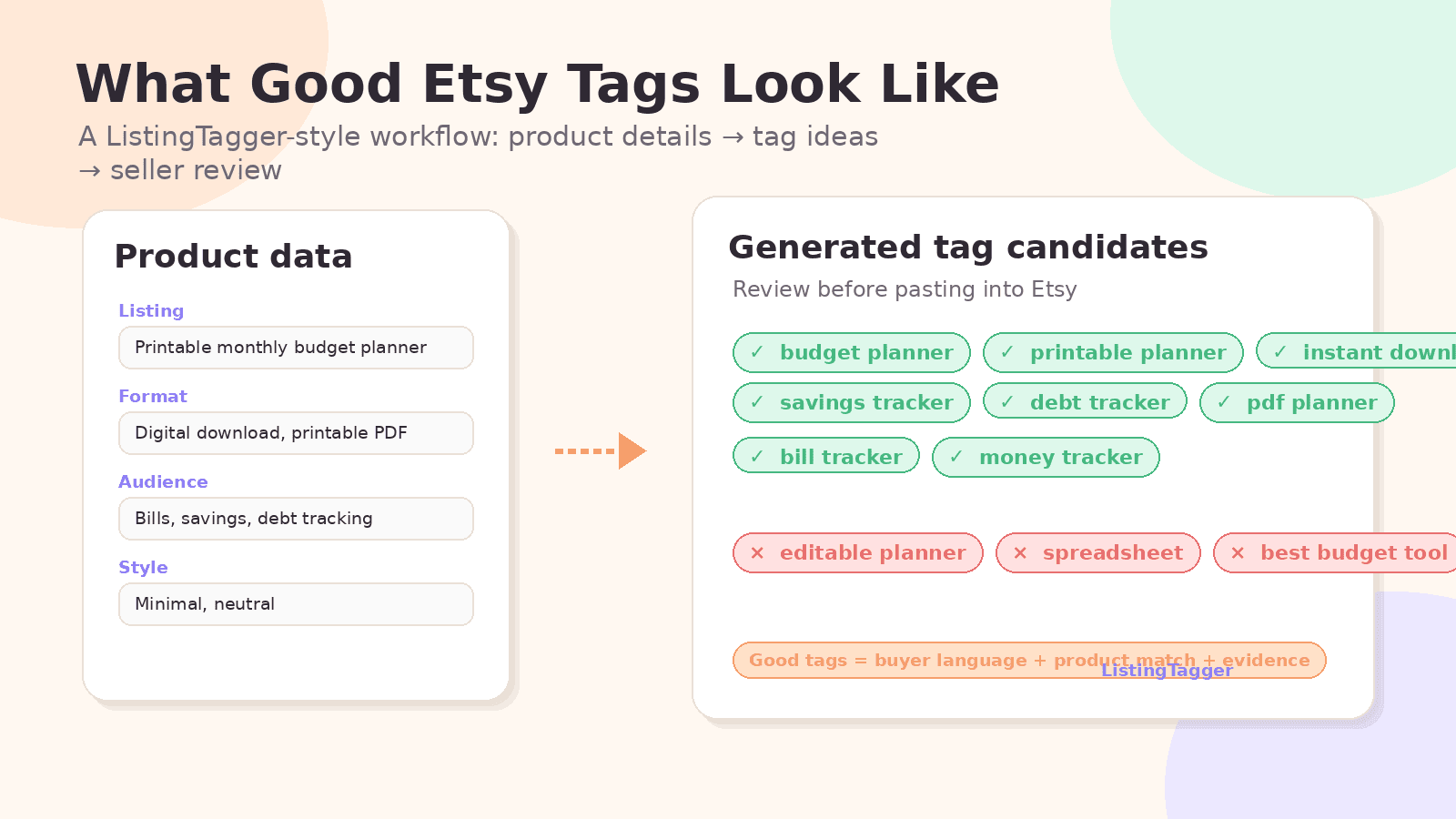
Product data:
textListing: Printable monthly budget planner PDF
Format: digital download, printable PDF
Audience: people tracking bills, savings, and debt
Style: minimal, neutral
Not included: editable spreadsheet, physical notebook
Possible good tags:
| Tag | Evidence note | |---|---| | budget planner | Exact use case | | printable planner | Format + product | | monthly planner | Time structure | | savings tracker | Included page/use case | | debt tracker | Included page/use case | | bill tracker | Buyer problem | | finance planner | Broader category wording | | money tracker | Buyer-language variant | | pdf planner | Delivery format | | instant download | Digital delivery | | minimal planner | Style, if visible | | budget printable | Format + use case | | cash envelope | Only if the file includes it |
Rejected tags:
| Rejected tag | Why | |---|---| | editable planner | Not editable | | spreadsheet | Product is a PDF, not a spreadsheet | | best budget tool | Hype phrase, not a clean Etsy tag |
That is the kind of output I trust more, because it explains the choices. It also catches mismatches before they become listing problems.
How to refresh old tags without wrecking a listing
Do not rewrite all 13 tags every time you feel impatient. Review them when there is a reason:
- the product changed
- the category or attributes changed
- the listing has enough Etsy Search Analytics data to review
- autocomplete or competitor wording suggests a better phrase
- you notice a tag no longer describes the item accurately
If a listing is new, I would avoid panic-editing tags after two slow days. Etsy tags are not a rescue button for weak photos, confusing prices, or a product with no demand. They are part of the listing’s context.
FAQ
What are good tags for Etsy?
Good tags for Etsy are short buyer-language phrases that describe the exact product and help Etsy understand the listing. Strong tags usually include a product type plus a useful detail such as material, style, recipient, occasion, format, or use case.
How many good tags should I use on Etsy?
Etsy allows up to 13 tags per listing. Use all reasonable slots if each tag adds real context. Do not fill empty slots with vague words just to reach 13.
What is the maximum length for an Etsy tag?
Each Etsy tag can be up to 20 characters. If a phrase is too long, split it into shorter tags or choose the clearest part of the phrase.
Are good Etsy tags the same as popular Etsy tags?
No. A popular phrase can still be a bad tag if it does not match your exact item. Good tags need relevance first, then validation from autocomplete, similar listings, shop analytics, or third-party tools.
Should I use AI to create Etsy tags?
You can use AI to draft tag ideas, but bind it to real product details and checked sources. Ask it to explain the evidence for each tag and reject weak tags. Do not let it invent search volume, ranking claims, or trend numbers.
Should I copy tags from a successful Etsy listing?
No. Similar listings can help you notice category wording, but copying tags blindly is risky. You do not know whether that listing performs because of tags, photos, reviews, price, age, or outside traffic.
What is one cold-detail question most tag guides skip?
Ask whether the tag creates a fulfillment expectation. For example, instant download, editable invite, personalized gift, and gift wrapped are not just keywords. They imply what the buyer will receive. If the listing does not deliver that promise, the tag is bad even if the wording looks searchable.
What is the fastest way to test tag ideas?
Use ListingTagger’s Free Etsy Tag Generator to draft candidates, then manually score each tag for relevance, buyer language, Etsy limit fit, unique angle, and evidence source. Keep the tags you can explain.