Most new Etsy sellers do not need a complicated keyword tool to start finding better tags. They need a repeatable way to turn one product into a set of search phrases a real buyer might type.
The short answer is this: start with the exact product name, expand it with material, style, recipient, occasion, and use case, then check the phrases against Etsy search behavior, Google suggestions, competitor listings, and your own listing data. Keep the final tags relevant, specific, and varied.
This guide gives you a practical step-by-step method for finding Etsy tags without guessing.
Quick answer: how do you find Etsy tags?
To find Etsy tags for a listing, use this simple process:
1. Write down the plain product name. 2. Add product details buyers care about. 3. Turn those details into short buyer search phrases. 4. Check Etsy autocomplete and similar listings for wording ideas. 5. Use Google suggestions to confirm how people phrase the problem. 6. Remove tags that are too broad, repeated, or irrelevant. 7. Choose up to 13 tags that each add a different angle. 8. Review the tags after the listing has real search and sales data.
For example, if you sell a handmade lavender soy candle, do not stop at tags like candle, gift, and home decor. Build a set that covers the product from several useful angles:
- soy candle
- lavender candle
- scented candle
- candle gift
- self care gift
- housewarming gift
- relaxing candle
- cozy home decor
- handmade candle
- natural candle
- spa gift
- bathroom candle
- gift for friend
The goal is not to chase random trending words. The goal is to help Etsy understand what the item is and match it with searches that make sense.
For a plain-English breakdown of what are good tags for Etsy, compare your draft tags against those examples before publishing.
Why this question matters
When we checked Google search suggestions for “how to find etsy tags,” Google returned related searches such as:
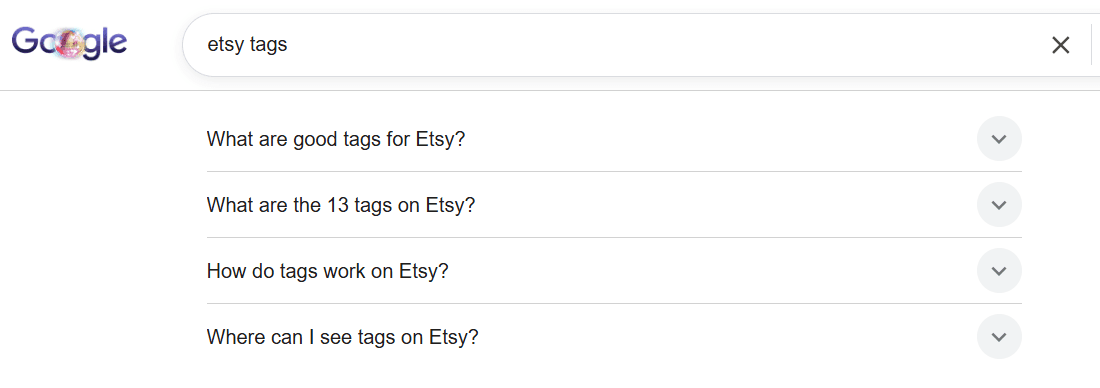
- how to find etsy tags
- how to see etsy tags
- how to find best etsy tags
- how to find etsy listing tags
- how to see etsy listing tags
- how to use tags on etsy
- tags for etsy listings
That pattern shows a clear search intent: sellers are not only asking what tags are. They want a working method for finding tags they can actually put into a listing.
A good article should answer that directly. So instead of giving vague advice like “do keyword research,” let’s walk through the exact process.
Step 1: Start with the product name buyers already use
Your first tag ideas should come from the simplest description of the product.
Ask:
If a buyer wanted this item, what would they call it before they knew my brand existed?
Examples:
| Product | Starting tag ideas | |---|---| | Silver necklace | silver necklace, dainty necklace | | Printable budget planner | budget planner, printable planner | | Lavender soy candle | soy candle, lavender candle | | Wedding favor candle | wedding favors, candle favors | | Nursery wall art | nursery wall art, wall art print |
Do not skip this step because it feels obvious. Etsy needs clear product context, and buyers often search in plain language.
Weak starting tags usually look like this:
- cute
- gift
- handmade
- aesthetic
- unique
Those words may describe the product emotionally, but they do not clearly explain what the item is. Use them only when they support a more specific phrase.
Step 2: Expand the product into buyer search angles
Once you have the product name, add the details buyers might use to narrow their search.
Use this framework:
textProduct type + Material + Style + Recipient + Occasion + Use case
You do not need every category for every product, but the framework helps you stop repeating the same idea.
Example: necklace
- product type: necklace
- material: silver, gold, pearl
- style: dainty, minimalist, boho
- recipient: gift for her, mom gift, bridesmaid gift
- occasion: birthday gift, wedding gift, anniversary gift
- use case: everyday necklace, layering necklace
Possible tags:
- silver necklace
- dainty necklace
- minimalist jewelry
- gift for her
- birthday gift
- bridesmaid gift
- everyday necklace
- layering necklace
Example: digital planner
- product type: planner
- format: printable, digital download, PDF
- style: minimalist, cute, neutral
- audience: student, small business owner, mom
- use case: budget planner, weekly planner, habit tracker
Possible tags:
- printable planner
- digital planner
- budget planner
- weekly planner
- habit tracker
- student planner
- instant download
Example: candle
- product type: candle
- material: soy wax, beeswax
- scent: lavender, vanilla, citrus
- occasion: housewarming gift, birthday gift
- mood: relaxing, cozy, spa night
- room: bathroom, bedroom, living room
Possible tags:
- soy candle
- lavender candle
- scented candle
- relaxing candle
- housewarming gift
- spa gift
- cozy home decor
This is the fastest way to create useful tag ideas without staring at a blank screen.
Step 3: Turn details into short phrases, not keyword stuffing
Etsy tags work best when each tag is a short phrase with a clear meaning. A tag does not need to be a perfect sentence. It should be compact and useful.
For example:
| Too broad or awkward | Better tag idea | |---|---| | jewelry | silver necklace | | planner | printable planner | | decor | kitchen wall art | | gift for woman who likes candles | candle gift | | very cute handmade minimalist home decoration | minimalist decor |
A common mistake is trying to pack every possible word into a tag. That creates messy tags that are hard to review.
A better approach is to give each tag a job:
- one tag for the product type
- one tag for the material
- one tag for the style
- one tag for the recipient
- one tag for the occasion
- one tag for the use case
- one tag for the format or delivery method, if relevant
When every tag has a job, your final set becomes easier to improve.
Step 4: Use Etsy autocomplete for buyer wording
Etsy autocomplete can help you see how shoppers phrase searches.
Try this:
1. Open Etsy search. 2. Type the plain product name, such as “soy candle.” 3. Notice the suggestions Etsy shows. 4. Repeat with a material, style, or recipient, such as “lavender candle” or “gift for friend.” 5. Write down phrases that accurately match your product.
Do not copy every suggestion blindly. Autocomplete can give you wording ideas, but your tags still need to describe the actual item.
Good use of autocomplete:
- You sell a printable budget planner.
- Etsy suggests phrases around “budget planner,” “cash envelope,” or “savings tracker.”
- You choose only the phrases that match what the file actually includes.
Bad use of autocomplete:
- You sell a simple weekly planner.
- You add “wedding planner” because it appears as a popular phrase.
- Buyers who search for wedding planning help will not want your weekly planner.
Relevance matters more than chasing volume.
Step 5: Look at similar listings, but do not copy blindly
Competitor listings can help you understand category language. They should not become a copy-and-paste source.
When reviewing similar listings, look for patterns:
- What product words appear again and again?
- Do sellers mention material, style, occasion, or recipient?
- Are there repeated phrases buyers likely understand?
- Are there phrases that are too broad or unrelated?
For example, if many successful wall art listings use phrases like “kitchen wall art,” “printable wall art,” and “gallery wall print,” those may be useful wording ideas if they fit your item.
But avoid copying tags exactly from one listing. You do not know whether those tags caused the listing to perform well. The shop may be ranking because of photos, reviews, price, age, conversion rate, or outside traffic.
Use competitors for language research, not as a shortcut.
Step 6: Check Google suggestions for problem wording
Google suggestions are useful because they show how people phrase search questions outside Etsy.
For this article, Google suggested related searches around:
- finding Etsy tags
- seeing Etsy listing tags
- finding the best Etsy tags
- using tags on Etsy
- tags for Etsy listings
That tells us the content should answer “how to find tags” directly, not only explain what Etsy SEO is.
You can use the same method for your product category:
1. Search Google for your product plus “Etsy tags.” 2. Look at the autocomplete suggestions. 3. Look for question patterns, such as “how to,” “best,” “for beginners,” or “for [product type].” 4. Use those patterns to understand buyer and seller language.
This helps with two things:
- finding tag ideas for Etsy listings
- writing clearer listing titles, descriptions, and article content that can be understood by search engines and AI answer engines
For GEO, or generative engine optimization, this matters because AI search systems tend to prefer content that gives a direct answer, clear steps, examples, and definitions. A page that answers the exact question “how do you find Etsy tags?” is easier for both people and AI systems to summarize accurately.
Step 7: Remove repeated words where they do not add value
New sellers often use 13 tags that repeat the same core word too many times.
For example, this tag set is repetitive:
- candle
- candles
- soy candle
- soy candles
- scented candle
- candle gift
- candles gift
- handmade candle
- handmade candles
Some repetition is natural, but too much repetition wastes space. Etsy can already understand related words across your title, tags, categories, and attributes. Use your tag slots to add new context.
A stronger candle tag set might be:
- soy candle
- lavender candle
- scented candle
- candle gift
- housewarming gift
- self care gift
- relaxing candle
- spa gift
- cozy home decor
- handmade candle
- natural candle
- bathroom candle
- gift for friend
This set still includes the core product, but it also adds occasion, recipient, mood, material, and use case.
Step 8: Do not panic when a useful tag shows low search volume
Keyword tools can be helpful, but they are not perfect. Some useful product phrases may show low or no search volume, especially for niche handmade items or new product trends.
That does not always mean the tag is bad.
A phrase can still be useful if:
- it accurately describes the product
- buyers would understand it
- it matches the title, photos, and description
- it captures a specific use case
- it helps Etsy understand the listing context
For example, “strawberry push pins” may look tiny compared with a broad term like “office decor,” but it describes a very specific product. If that is what the buyer wants, the specific phrase may be more valuable than a broad phrase with more competition.
Use search volume as one signal, not the final decision.
Step 9: Build the final 13-tag set
Before you publish, organize your tag set so each tag covers a different angle.
Use this checklist:
| Tag role | Question to ask | Example | |---|---|---| | Product type | What is the item? | soy candle | | Material | What is it made from? | soy wax candle | | Style | What style does it fit? | minimalist decor | | Recipient | Who might buy it or receive it? | gift for friend | | Occasion | When would someone buy it? | housewarming gift | | Use case | How is it used? | relaxing candle | | Format | Is it physical or digital? | instant download | | Niche phrase | What specific buyer phrase fits? | lavender candle |
You do not need one tag from every row. Use the rows that fit your product.
A good final set should pass three tests:
1. Every tag is relevant. 2. The tags do not all repeat the same idea. 3. A buyer who searched those phrases would not feel misled.
Step 10: Use a generator for brainstorming, then edit like a seller
A tag generator can save time when you are stuck. It can turn a product description into a starting list of tag ideas.
You can use ListingTagger’s Free Etsy Tag Generator to brainstorm up to 13 Etsy tag ideas, then review them before publishing.
The important part is the review. Do not paste generated tags into Etsy without checking them.
Ask:
- Does this tag describe the actual item?
- Is it within Etsy’s tag limits?
- Does it add a new angle?
- Is it too broad?
- Is it misleading?
- Would a buyer searching this phrase be happy to see my listing?
AI can speed up brainstorming. Your judgment keeps the tag set accurate.
Example: finding tags for one Etsy listing
Let’s say the product is a printable nursery wall art set with neutral animal illustrations.
Product details
- product type: wall art print
- format: printable, digital download
- room: nursery
- style: neutral, minimalist
- theme: animals
- buyer: parents, baby shower shoppers
- use case: nursery decor, baby room decor
Rough tag ideas
- wall art
- nursery wall art
- printable wall art
- animal wall art
- neutral nursery
- baby room decor
- digital download
- minimalist print
- safari animals
- baby shower gift
- kids room art
- printable decor
- nursery prints
Edited final tag set
- nursery wall art
- printable wall art
- animal wall art
- neutral nursery
- baby room decor
- digital download
- minimalist print
- safari animals
- baby shower gift
- kids room art
- printable decor
- nursery prints
- wall art set
This set is not perfect for every product, but it is much stronger than starting with broad tags like art, baby, cute, and printable.
How often should you change Etsy tags?
Do not change tags every day just because a listing has not sold yet. Etsy listings need time to gather impressions, clicks, and conversion data.
A practical approach:
- For a new listing, publish with your best researched tags.
- Wait long enough to collect meaningful data.
- Review Etsy stats for views, clicks, and search terms.
- Change only the weakest tags first.
- Keep tags that are bringing relevant traffic.
If a listing is already selling, be careful with large tag changes. Improve slowly unless the current tags are clearly irrelevant.
Common mistakes when finding Etsy tags
Mistake 1: Using only one-word tags
One-word tags like gift, art, or jewelry are usually too broad. Use more specific phrases when possible.
Mistake 2: Copying competitors exactly
Competitor tags can show language patterns, but copying them does not guarantee results. Your product, photos, price, reviews, and shop history are different.
Mistake 3: Chasing trends that do not match the product
A trendy phrase is not useful if it brings the wrong buyer. Tags should describe the item honestly.
Mistake 4: Repeating the same word in every tag
Some repetition is fine, but 13 tags should not all say the same thing. Add material, style, recipient, occasion, and use case.
Mistake 5: Trusting search volume blindly
Low-volume phrases can still work for specific products. High-volume phrases can be too competitive or too broad.
A simple tag research workflow you can reuse
Use this workflow whenever you create a new Etsy listing:
1. Write the exact product type. 2. List material, style, recipient, occasion, and use case. 3. Turn those details into short phrases. 4. Check Etsy autocomplete for wording ideas. 5. Review similar listings for category language. 6. Check Google suggestions for question and search patterns. 7. Generate extra ideas with ListingTagger if you are stuck. 8. Remove broad, repeated, or misleading phrases. 9. Choose up to 13 tags. 10. Review performance later and improve slowly.
If you want a final review process before publishing, use our Etsy tag checklist for new sellers. If you want a broader strategy, read how to choose Etsy tags.
FAQ
What is the easiest way to find Etsy tags?
The easiest way is to start with the product name, add details like material, style, recipient, occasion, and use case, then turn those details into short search phrases. You can also use Etsy autocomplete, similar listings, Google suggestions, and a tag generator for ideas.
Should I copy Etsy tags from competitors?
No. You can study similar listings to understand common wording, but copying tags exactly is not a reliable strategy. You do not know whether those tags are helping the listing, and your product may need different wording.
Are Etsy tag tools accurate?
Etsy tag tools can be useful for brainstorming, but they are not perfect. Use them as one input, then review each tag for relevance, clarity, and fit with your actual product.
What if an Etsy tag has no search volume?
A tag with low or no visible search volume can still be useful if it accurately describes a specific product and matches how a real buyer might search. Do not rely on volume alone.
How many Etsy tags should I use?
Etsy allows up to 13 tags per listing. In most cases, use all 13 if you can fill them with relevant, non-repetitive phrases.
Can ListingTagger find Etsy tags for me?
ListingTagger can help you brainstorm Etsy tag ideas from your product information. Use the generated tags as a starting point, then edit them before publishing so they accurately match your listing.
ListingTagger is not affiliated with Etsy. Tag examples are for brainstorming and should be reviewed before publishing.